

SAAPE’S ENGAGEMENT IN THE GLOBAL CIVIL SOCIETY MOBILISATION DURING THE IMF–WORLD BANK ANNUAL MEETINGS
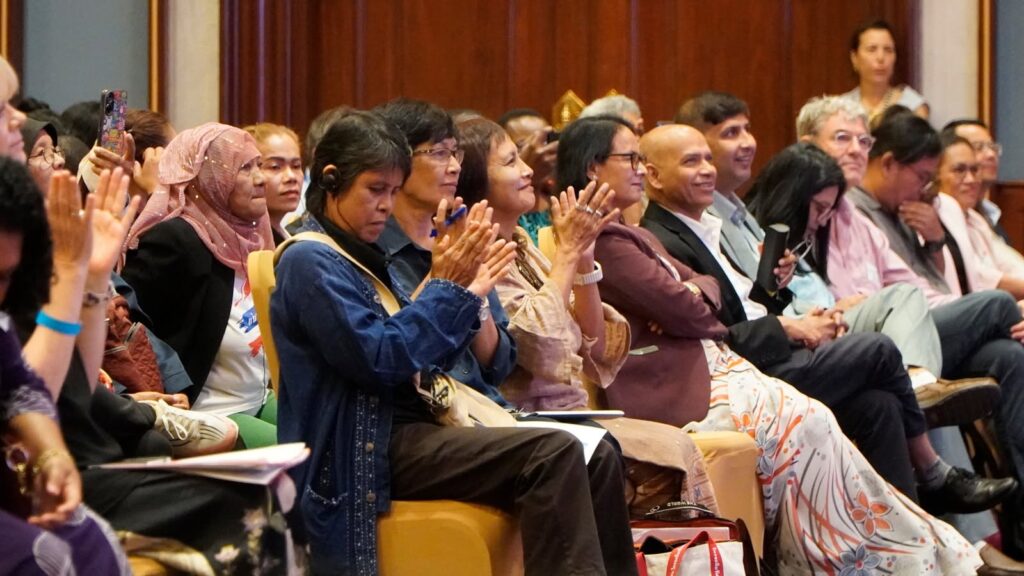
On 12 October, SAAPE also participated as a co-organiser of the thematic session “From Inequality to Action: Connecting People’s Struggles for Economic Justice.” The session brought together civil society organisations and social movements to examine how inequality is produced and sustained through political and economic choices related to debt, taxation, public spending and economic policy.
The session was jointly organised by a broad coalition including Global Call Against Poverty (GCAP), Fight Inequality Alliance (FIA), Oxfam in Asia, SAAPE, End Austerity Campaign (EAC), Global Alliance Against Incinerators (GAIA), Center for Finance Accountability (CENFA) and Tax Justice Network–Africa, among other participating organisations. Participants explored the political and economic choices driving inequality in their communities and examined how different struggles intersect. The session also introduced the “We the 99% People’s Declaration” as a people-led framework for connecting struggles and building collective alternatives. A participatory group discussion enabled participants to identify common challenges, priorities and opportunities for collective action beyond Bangkok.
The session provided an opportunity to connect South Asian experiences of inequality, insecure livelihoods, inadequate social protection, gender disparities and limited public investment with wider regional and global struggles for economic justice. The discussion reinforced the importance of linking debt justice, tax justice, climate justice and social justice, and of building stronger alliances among civil society organisations, social movements and affected communities.
Debt, Tax, Fiscal Justice and International Finance
SAAPE contributed to the thematic session “Debt, Tax, Fiscal Justice and International Finance,” organised as part of the International People’s Assembly (IPA)held alongside the 2026 IMF–World Bank Annual Meetings in Bangkok on 12 October 2026. The session brought together civil society organisations and social movements from Asia, Africa, Latin America and other regions to examine the interconnected challenges of sovereign debt, taxation, fiscal policy and the international financial architecture. The session was convened by the APMDD, together with a broad coalition of civil society organisations, including Recourse and AFRODAD, which supported the thematic discussions, while LATINDADD contributed to the wider civil society engagement during the Annual Meetings.
Dr. Netra Prasad Timsina, Regional Coordinator of SAAPE and Executive Director of Rural Reconstruction Nepal (RRN), participated as a panelist, bringing perspectives from South Asia to the regional and global discussion on debt, taxation and fiscal justice. The panel also featured representatives from LATINDADD, Debt Justice, PRIED, ESCR-Net and Social Investment and Development (SID), with the discussion facilitated by Mae Buenaventura and Jeannie Manipon of APMDD.
Dr. Timsina highlighted the importance of bringing the experiences and concerns of South Asian countries into discussions on the international financial system. Countries across the region are facing interconnected pressures from high debt burdens, constrained fiscal space, persistent inequality and increasing climate-related vulnerabilities. These challenges directly affect governments’ capacity to invest in essential public services, social protection, climate resilience and inclusive development. The discussion provided an opportunity to examine how international financial institutions and global economic policies influence national fiscal choices, and how developing countries can strengthen their policy space to pursue more equitable, sustainable and people-centred development pathways.
The session underscored that debt justice, tax justice and fiscal justice are closely interconnected. High debt-service obligations can restrict public spending, while regressive tax systems can place a disproportionate burden on low- and middle-income households. At the same time, tax avoidance, illicit financial flows and weaknesses in the international tax architecture continue to undermine the ability of developing countries to mobilise adequate domestic resources. Participants discussed the need to transform the international financial architecture so that it supports people-centred development, adequate public financing, greater policy space and democratic accountability, rather than reinforcing cycles of debt and fiscal constraint.
The discussion also contributed to the broader agenda of the International People’s Assembly, which brought together movements and civil society organisations to develop shared perspectives and collective demands towards the IMF, World Bank and governments participating in the Annual Meetings. The discussions emphasised the importance of strengthening Global South perspectives and building collective advocacy for reforms to the international economic and financial system. The session formed part of the broader civil society mobilisation around the IMF–World Bank Annual Meetings, where organisations and movements from different regions came together to advance alternatives to policies that deepen inequality and constrain the public resources needed for social protection, essential services and climate action.