

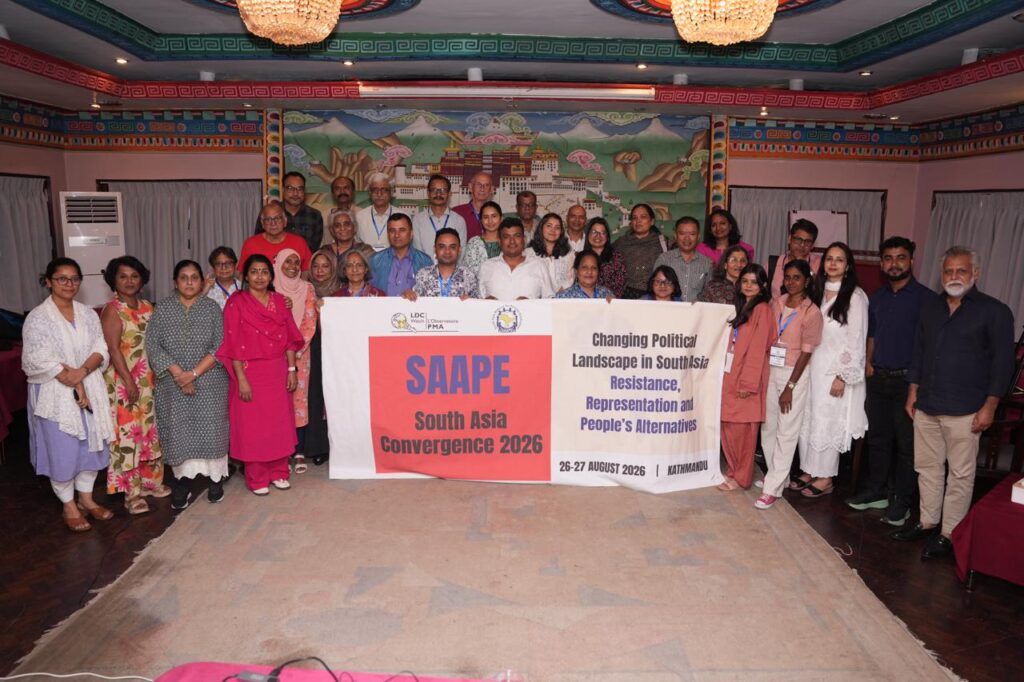
On 26-27 August 2026, the South Asia Alliance for Poverty Eradication (SAAPE) marked its 25th anniversary with a two-day regional gathering that reflected on its legacy and explored pathways for a more just and inclusive future. The event opened with a documentary on SAAPE’s 25 year journey, followed by reflection from the Regional Coordinator of SAAPE Dr. Netra Timsina on structural inequality, climate crisis, shrinking civic space, and the continuing role of people’s movement in South Asia. In his keynote address, John Samuel highlighted the challenged posed by surveillance capitalism, misinformation, monopoly power, and youth unemployment, while calling on social movements to ‘reimagine and remain relevant’. The convergence had a regional youth panel which echoed concerns over unemployment, migration, climate change, and democratic deficits, emphasizing the need for meaningful youth leadership and participation. The session on the thematic roundtable, discussions on the climate justice, workers’ rights, economic justice, and gender equality, participants called for stronger regional cooperation, universal social protection, progressive fiscal policies, and people-centered development.
The second day focused on SAAPE’s forthcoming Poverty and Vulnerability Report 2027, featuring presentations from the country across the region and regional policy reviews on the poverty, inequality and social protection. Discussions also examined the opportunities and challenges of Least Developed Country (LDC) graduation, with speakers from the Maldives, Bangladesh, and Nepal highlighting concerns around trade, employment, migration, debt, and policy space. The convergence adopted the Kathmandu Declaration 2026, highlighting the concerns over democratic decline, rising inequality, climate crisis and shrinking civic space in the region. It urged governments to strengthen democracy, youth and women’s participation, workers’ rights, social protection, climate justice, public services and regional solidarity while rejecting privatisation, discrimination and corporate-driven development models. The Convergence formulated a strategy based on the suggestions received from the participants of the convergence. Strategy aims to explore and advance feminist and climate justice, strengthen youth political education and representation within SAAPE, recognise grassroots alternatives, address emerging forms of economic exclusion such as platform work, artificial intelligence and digital inequality, and deepen South-South solidarity across the region. The convergence concluded with a renewed commitment to collective action, intergenerational leadership, and regional solidarity in addressing the region’s common challenges.